
Urgent Dental Care
Emergency Dentist in Belpre, OH
What is considered a dental emergency?
An injury to or infection in your teeth, gums, or mouth that results in severe pain or discomfort. Often, these are time sensitive issues that need addressed quickly before they:
- pose more serious health risks
- damage the appearance of your teeth and facial esthetics
- require much more invasive and costly treatment
- See detailed descriptions of various dental emergencies below.
When in doubt, make the call.
Is emergency care available around the clock?
Emergency dental care cannot be provided 24/7 like hospital emergency room care. That being said, limited care is available to patients currently undergoing treatment who encounter an issue. If that is you, call between the hours of 8am – 9pm for assistance.
Why isn’t emergency care available 24/7?
- Dental emergencies are too infrequent to justify an emergency clinic. It would be empty all the time.
- Our small staff is committed to our normal business hours and thus not available to work outside of normal hours.
- We cannot safely deploy staff to provide care alone in an empty clinic.
- Most dental emergencies (facial trauma excluded) can be prevented by routine care and timely restorative care to address issues as they develop. Unfortunately, neglecting your dental care can have painful, more expensive, and regrettable results.
What should our established patients do if they have a dental emergency?
- Be proactive if you have symptoms developing. Call the office during normal business hours. We want to work you in for treatment while staff is on duty to properly diagnose and address your issue. Don’t wait until you are in crisis.
- If the office is closed, you can call before 9pm for a telehealth consult. The earlier you call the better since our doctor and staff are not on duty and it can take time to make contact with them and develop a plan. Moreover, if you require an antibiotic, pharmacies close early.
- After 9pm, if you cannot bear the pain or other symptoms you are experiencing, you should proceed to an emergency room. After 9pm, our phones roll to voicemail to be addressed the following day.
- If you are in the middle of a treatment plan and you encounter problems, we will make every effort to address your issue.
- If you go to the emergency room, understand that their goal will be to medically stabilize you. They do not have the equipment or training to address dental issues. Often the antibiotics prescribed are not optimal. Additionally, antibiotics cannot cure an abscessed tooth. They can only control the symptoms during the short-term. For this reason, it is critical that you call us the following day so we can schedule you to be properly diagnosed and treated.
- Follow the instructions you were given during treatment to prevent problems and optimize your recovery.
What if you are not a current patient of our practice?
- Phone our offices during normal business hours.
- Describe your issue so our Patient Service Coordinator can advise you on when we are able to work you into our schedule.
We will get you established as a patient with the practice by scheduling a New Patient Hygiene appointment. During these appointments, we will collect a complete medical and dental history, take diagnostics, prepare your mouth for treatment by cleaning your teeth, perform an examination to determine what emergency and other restorative care you need.
Sometimes, emergency care can be provided during that appointment depending on the seriousness, the need for pre-treatment, and staff availability.
No after-hours telehealth can responsibly be provided to patients for whom we have no medical history and proper diagnostics. You must be an established patient to receive telehealth services.
What Dental Problems Require Urgent Care?
Toothache
Ranging from a mild annoyance to severe pain, a toothache often indicates the presence of a cavity or tooth damage that extends to the nerve. More severe pain indicates a higher level of damage and potentially spreading infection, which should be addressed immediately.
Damaged or Broken Crown
Porcelain crowns are very durable, but it’s not unusual for them to come off or break, especially if they’ve been in place for a long time. Often characterized by sensitivity or even excruciating pain, a broken crown significantly weakens the tooth. If your crown breaks or falls out, it’s crucial to get a replacement as soon as possible.
Dislodged Tooth
When a tooth becomes dislodged (knocked out partially or completely) due to facial trauma or other injury (like an accident or sports injury), it can be salvaged if a dentist can restore it in its socket as soon as possible. Because this requires you to act quickly to prevent you from permanently losing the damaged tooth or teeth, it is considered a serious dental emergency. Place any dislodged teeth in cold milk whenever possible.
Other Dental Emergencies
- Chipped tooth
- Impacted wisdom teeth
- Abscessed tooth
- Facial swelling
- Broken braces or other dental appliances (for broken braces, contact your orthodontist!)
- Traumatic injury to the mouth
What to Expect
We want you to feel at ease, knowing that we are very experienced in treating dental emergencies. No matter the situation, we can help to save and restore your smile.
Once you arrive, staff will examine your mouth and face and provide the following as needed:
- Pain relief
- X-rays
- Teeth cleaning in preparation for treatment whenever possible
- Examination by the dentist who will communicate your treatment plan
- Treatment, temporary treatment, or pre-treatment will be provided as indicated
- Scheduling of follow-up care as needed
Dental emergency?
Contact us ASAP to preserve your smile.

Learn more about what we offer:
General Dentistry
Pediatric Dentistry
Dentistry for Anxious Patients
Smile Makeovers
Insurance & Financing
Emergency treatments are often temporary in nature, as the primary goal of emergency care is to alleviate pain and discomfort, stop any bleeding, and prevent further damage to your oral and general health.
Why can’t all the treatment be provided at the first visit?
Sometimes it can. Sometimes follow-up appointments are required for a variety of reasons such as:
- Too much infection is present to safely treat without significant risk like heart damage
- Healing time is necessary to ensure a quality outcome
- Permanent fix will require more time than available
Check out this emergency fix by Dr. Stephen A. Huffman!
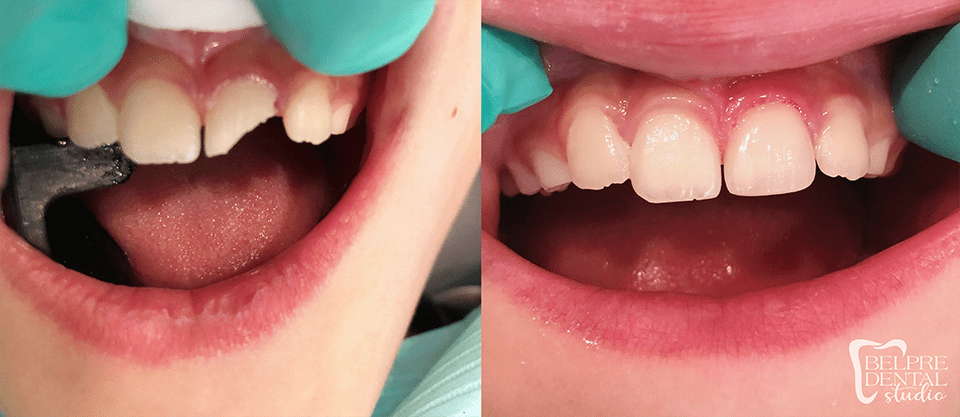
Patient/ Parent Concerns: “My son broke his tooth on a metal pole at school.”
Dentist Diagnosis: Enamel-dentine fracture.
Treatment: Due to the patient’s young age of 9 years, and since he is still growing, the final fix is desired to be achieved with direct bonding of white filling material instead of crowns or veneers. Dr. Stephen Huffman completed and restored the tooth with accurate anatomy, dimensions, and shade using skills taught at Ohio State pre-clinic by Dr. Rafat Amer.
Why should I have dental cleanings on the recommended schedule?
You may have heard the proverb, “An ounce of prevention is worth a pound of cure”. This rings true to oral health as well!
🦠Like the rest of the body, your mouth fights hard against stressors to prevent dental disease and damage.
😱However, once the tipping point is reached, conditions and risks can change rapidly.
🚭Bad habits like infrequent brushing and smoking or changes in general health like developing diabetes can result in a sudden onset or worsening of symptoms.
⌚The sooner a dentist catches the issue, the simpler and less expensive it is to treat it.
💰For example, a filling can turn into a root canal, and a gum treatment can turn into a gum graft